|
Click on images to see larger
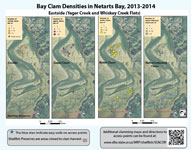
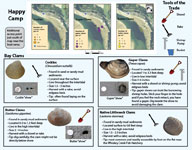
The information we collected during the shellfish and estuarine assessment in 2013-2014 enabled us to map the location, density, and associated habitat features of bay clams in Netarts Bay. The two types of maps presented on this webpage display where we found clams during our survey.
The first type of map is the Clamming Maps of Netarts Bay. These maps present the bay clam densities in recreationally important clamming areas on the east and west side of the bay. The four bay clam species include cockle, gaper, butter, and native littleneck clams.
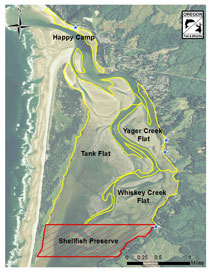
| Recreationally important clamming areas sampled during the study |
Happy Camp
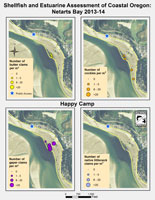
Happy Camp is the northernmost recreational area within Netarts Bay. The upper beach is sandy but the lower beach is a mix of sand, cobble, and bedrock. Many species of microalgae were found on these lower intertidal areas. Gaper clams were common at Happy Camp; cockles and butter clams were also found at this location. Few native littlenecks were found in our random samples. The lower intertidal cobble found at Happy Camp makes harvesting clams on this flat more challenging than other parts of the bay.
Happy Camp Clam Densities (pdf) |
|
Yager Creek Flat
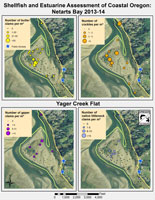
Yager Creek Flat is a popular reactional flat on the east side of Netarts Bay. This flat has easy walk-on access to a broad sandy intertidal beach with areas of native eelgrass (Zostera marina). While four species of bay clams were found in this flat, butter clams occurred in the highest densities.
Yager Creek Flat Clam Densities (pdf) |
|
Whiskey Creek Flat
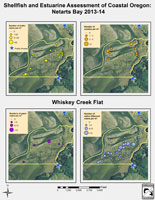
Whiskey Creek Flat is south of Yager Creek Flat. It has large patches of muddy sediments where burrowing shrimp are common. Large beds of native eelgrass (Zostera marina) are present on this flat. All four species of bay clams were found in this region with one of the bay’s largest areas of native littleneck clams. However, Gaper clams were less common here than in other areas of the bay.
Whiskey Creek Flat Clam Densities (pdf) |
|
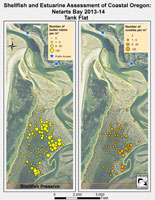
Tank Flat
Tank Flat is on the west side of the bay and is only easily accessible by boat. This flat is less utilized by recreational clammers than other parts of the bay; however, most of the commercial oyster leases in Netarts bay are located on Tank Flat. The north end of Tank Flat is dominated by highly dynamic sand flats. Non-native purple varnish clams were found on this part of Tank Flat. Further south, Tank Flat shifts to more sandy mud sediments with large expanses of both the native eelgrass (Zostera marina) and the non-native eelgrass (Zostera japonica). The only sand dollar (Dendraster excentricus) bed in Netarts Bay is found in this region of the flat. The middle and southern parts of Tank Flat support populations of all four bay clam species as well as burrowing shrimp.
Tank Flat Clam Densities (pdfs)
|
|
| Other areas sampled as part of this study |
Shellfish Preserve (East and West)
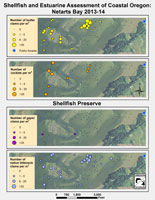
The Shellfish Preserve is located at the south end of the bay and is closed to all clam harvest. The area consists of multiple habitats from high sand beaches to dense beds of native eelgrass (Zostera marina). These habitats support a wide array of clam populations including all four bay clam species. Butter, cockles, and native littleneck clams were all found in high densities.
Shellfish Preserve Clam Densities (pdf) |
|
Subtidal Channels
The subtidal channels are areas of the bay that remain filled with water even at low tide. Often these areas are important regions to study when trying to understand clam densities of the whole bay system. Of the four bay clam species, cockles were most common in the subtidal channels of Netarts Bay.
Subtidal Channels Clam Densities (pdfs)
|
|
Overall, we found that region and habitat affect the distribution and number of the species we investigated.
Directions to Netarts clamming access points (pdf)
Contact the SEACOR project via e-mail at:
ODFW.SEACOR@odfw.oregon.gov |